Paid-Up Capital, Current-Year Profit/Loss, Retained Earnings and Accumulated Loss
Separate Paid-Up Capital, current-year profit/loss, Retained Earnings / Accumulated Loss, and Owner Distributions/Drawings. They are related, but they are not the same account.
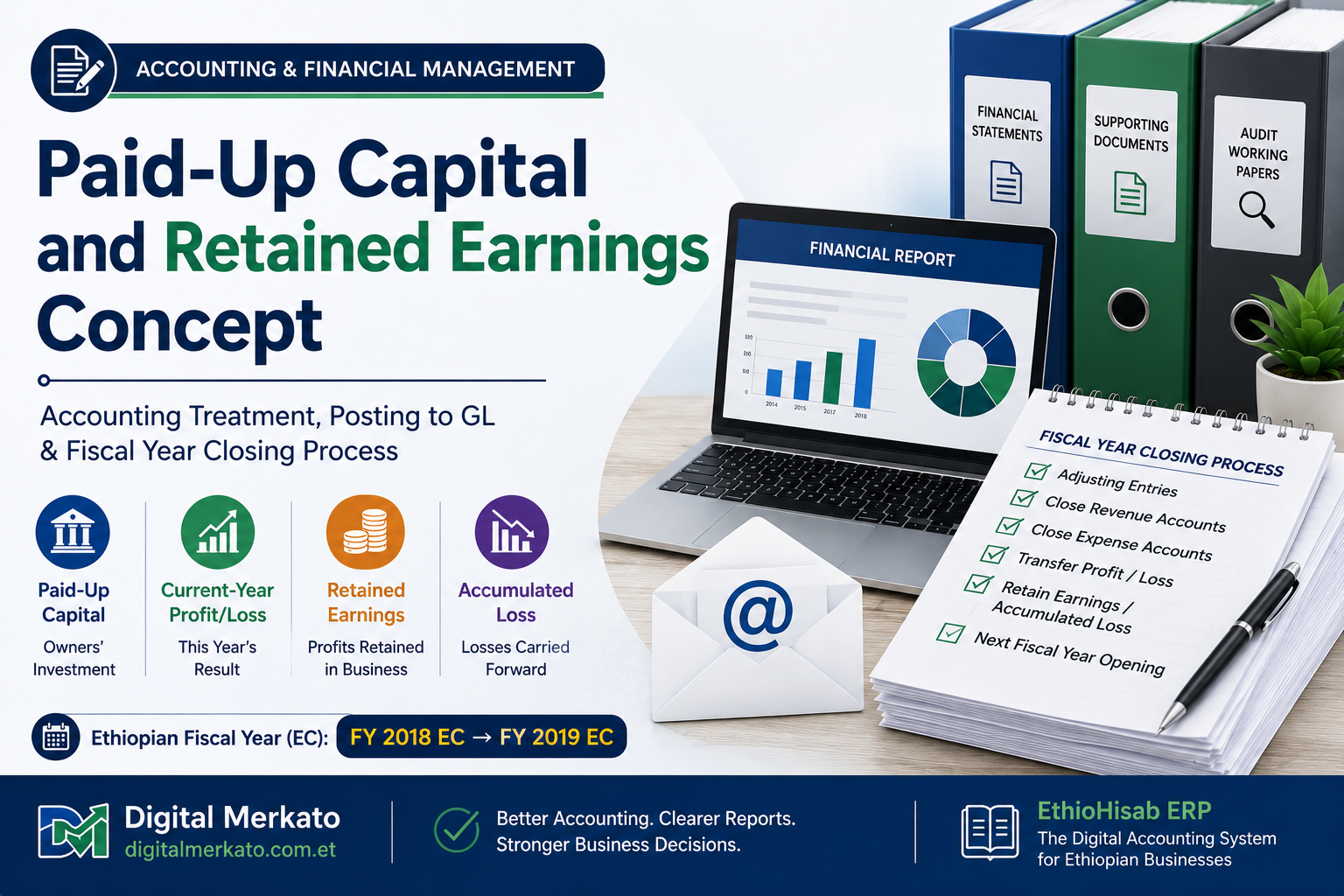
Paid-Up Capital, Current-Year Profit/Loss, Retained Earnings and Accumulated Loss
Accounting Treatment, GL Posting and the Ethiopian Fiscal-Year Closing Process
Understanding the relationship between Paid-Up Capital, Current-Year Profit or Loss, Retained Earnings, and Accumulated Loss is essential for correct accounting and financial reporting. These accounts all affect shareholders' or owners' equity, but they serve different purposes and must be treated differently in the General Ledger (GL). This article explains their accounting treatment using FY 2018 EC as the current fiscal year and FY 2019 EC as the following fiscal year.
1. Understanding the Main Equity Accounts
The first step is to distinguish between the major equity-related accounts.
| Account | Normal Balance | Permanent Account? | Closed at Year-End? | Main Purpose |
|---|---|---|---|---|
| Paid-Up Capital | Credit | Yes | No | Records capital contributed by owners/shareholders |
| Current-Year Profit/Loss | Credit for profit; Debit for loss | No | Yes | Represents the current fiscal year's financial result |
| Retained Earnings | Credit | Yes | No | Holds cumulative profits retained in the business |
| Accumulated Loss | Debit | Yes | No | Holds cumulative losses carried forward |
| Owner Drawings/Distribution | Debit | No | Yes / Transferred | Records qualifying temporary owner withdrawals/distributions |
| Dividend/Profit Distribution Payable | Credit | Yes until settled | No | Records an approved amount payable to owners/shareholders |
Important Accounting Principle
Paid-Up Capital must not be used to record ordinary annual profits or losses.
Paid-Up Capital represents the owners' investment in the company. Profit and loss arise from business operations and must flow through the appropriate income statement and equity accounts.
2. Paid-Up Capital
Paid-Up Capital represents money or other qualifying capital contributed by the owners or shareholders.
Assume an owner establishes a company and contributes ETB 1,000,000. The journal entry is:
| Account | Debit | Credit |
|---|---|---|
| Bank/Cash | ETB 1,000,000 | |
| Paid-Up Capital | ETB 1,000,000 |
After posting to the General Ledger:
- Assets — Bank/Cash = ETB 1,000,000
- Equity — Paid-Up Capital = ETB 1,000,000
Paid-Up Capital is a permanent equity account. It is not closed to zero when the fiscal year ends. Therefore, if the company closes FY 2018 EC with Paid-Up Capital of ETB 1,000,000, the same balance normally carries forward into FY 2019 EC unless there is an authorized capital increase or reduction.
3. Current-Year Profit During FY 2018 EC
Suppose the company has the following results during FY 2018 EC:
| Description | Amount |
|---|---|
| Revenue | ETB 3,000,000 |
| Expenses | (ETB 2,200,000) |
| Net Profit | ETB 800,000 |
Before the fiscal year is closed, the ETB 800,000 represents the Current-Year Profit. The equity section may therefore show:
| Equity Account | Balance |
|---|---|
| Paid-Up Capital | ETB 1,000,000 Cr |
| Current-Year Profit | ETB 800,000 Cr |
| Retained Earnings | ETB 0 |
| Total Equity | ETB 1,800,000 |
At this stage, the ETB 800,000 belongs to FY 2018 EC. It should not be added to Paid-Up Capital.
4. What Happens During FY 2018 EC Closing?
At fiscal year-end, revenue and expense accounts are temporary accounts and must be closed. The basic process is:
- Revenue Accounts → Current-Year Profit/Loss
- Expense Accounts → Current-Year Profit/Loss
The system determines the final net profit or loss. The result is then transferred to Retained Earnings (if the company has cumulative retained profit) or to Accumulated Loss (where the accounting presentation uses a separate accumulated-loss account).
For the ETB 800,000 FY 2018 EC profit, the closing transfer can conceptually be represented as:
| Account | Debit | Credit |
|---|---|---|
| Current-Year Profit / Income Summary | ETB 800,000 | |
| Retained Earnings | ETB 800,000 |
After FY 2018 EC is closed:
| Equity Account | Balance |
|---|---|
| Paid-Up Capital | ETB 1,000,000 Cr |
| Retained Earnings | ETB 800,000 Cr |
| Current-Year Profit | ETB 0 |
| Total Equity | ETB 1,800,000 |
Therefore, the basic rule is:
- Before Closing: FY 2018 EC profit appears as Current-Year Profit.
- After Closing: FY 2018 EC profit becomes part of Retained Earnings.
5. What Happens if the Company Makes a Loss?
Suppose instead that the company makes an ETB 300,000 loss during FY 2018 EC. Before closing:
| Equity Account | Balance |
|---|---|
| Paid-Up Capital | ETB 1,000,000 Cr |
| Current-Year Loss | ETB 300,000 Dr |
| Net Equity | ETB 700,000 |
If a separate Accumulated Loss account is used, the year-end transfer may be represented as:
| Account | Debit | Credit |
|---|---|---|
| Accumulated Loss | ETB 300,000 | |
| Current-Year Loss / Income Summary | ETB 300,000 |
After closing:
| Equity Account | Balance |
|---|---|
| Paid-Up Capital | ETB 1,000,000 Cr |
| Accumulated Loss | ETB 300,000 Dr |
| Net Equity | ETB 700,000 |
Important Point
A business loss does not automatically reduce the Paid-Up Capital GL account. Instead, the loss reduces total shareholders' equity through Retained Earnings or Accumulated Loss. Paid-Up Capital remains unchanged unless there is a formal capital reduction.
6. Retained Earnings vs. Accumulated Loss
Retained Earnings represents cumulative profits that have remained in the business after year-end closing and distributions. Accumulated Loss represents cumulative losses carried forward from previous fiscal years.
For example:
- FY 2018 EC — Profit = ETB 800,000
- FY 2019 EC — Loss = ETB 300,000
The cumulative result is ETB 800,000 − ETB 300,000 = ETB 500,000 retained profit.
Depending on the company's Chart of Accounts and reporting policy, this can be presented as one net Retained Earnings balance or through separate Retained Earnings and Accumulated Loss accounts. For an ERP system, maintaining separate system-controlled balances can provide clearer reporting and auditability, while the financial statements should present them consistently without double-counting.
7. What Happens When the Owner Increases Paid-Up Capital?
Suppose the company's existing Paid-Up Capital is ETB 1,000,000 and the owner contributes another ETB 500,000. The accounting entry is:
| Account | Debit | Credit |
|---|---|---|
| Bank/Cash | ETB 500,000 | |
| Paid-Up Capital | ETB 500,000 |
The new Paid-Up Capital balance becomes ETB 1,500,000. This ETB 500,000 is not revenue. It should not be posted to Sales Revenue, Other Income, or Retained Earnings. It is an owner/shareholder equity contribution.
8. What Happens When Paid-Up Capital Is Reduced?
Suppose the company formally reduces Paid-Up Capital by ETB 200,000 and returns the corresponding cash to the owner. The entry is:
| Account | Debit | Credit |
|---|---|---|
| Paid-Up Capital | ETB 200,000 | |
| Bank/Cash | ETB 200,000 |
If the previous Paid-Up Capital was ETB 1,000,000, the new balance becomes ETB 800,000.
However, reducing Paid-Up Capital is different from an ordinary owner withdrawal or profit distribution. A formal capital reduction should be supported by the required corporate approvals and applicable legal procedures. For this reason, accounting systems should distinguish between Capital Reduction and Owner Withdrawal / Dividend / Profit Distribution.
9. What if the Owner Takes Money When the Company Has Profit?
Suppose that after FY 2018 EC closing, the company has Paid-Up Capital = ETB 1,000,000 and Retained Earnings = ETB 800,000. The owners then properly approve a profit distribution of ETB 300,000.
At approval:
| Account | Debit | Credit |
|---|---|---|
| Retained Earnings / Profit Distribution | ETB 300,000 | |
| Dividend/Owner Distribution Payable | ETB 300,000 |
When the amount is paid:
| Account | Debit | Credit |
|---|---|---|
| Dividend/Owner Distribution Payable | ETB 300,000 | |
| Bank/Cash | ETB 300,000 |
After the distribution, assuming no other equity changes: Paid-Up Capital = ETB 1,000,000 and Retained Earnings = ETB 500,000.
Key Principle
Taking an approved share of company profit does not mean reducing Paid-Up Capital. The distribution normally reduces the company's accumulated distributable earnings/equity rather than its Paid-Up Capital.
10. What if an Owner Takes Money During the Fiscal Year?
An owner may sometimes take money from the company before the transaction has been formally classified or approved as a distribution. For example, the owner takes ETB 100,000. If the amount is expected to be repaid, an appropriate entry may be:
| Account | Debit | Credit |
|---|---|---|
| Shareholder/Owner Receivable | ETB 100,000 | |
| Bank/Cash | ETB 100,000 |
If the owner later repays the amount:
| Account | Debit | Credit |
|---|---|---|
| Bank/Cash | ETB 100,000 | |
| Shareholder/Owner Receivable | ETB 100,000 |
This approach prevents the accounting system from automatically treating every owner cash withdrawal as a dividend or reduction in Paid-Up Capital. The transaction can subsequently be reclassified based on its actual legal and accounting substance.
11. What if the Company Has Accumulated Losses and the Owner Takes Money?
Assume Paid-Up Capital = ETB 1,000,000 Cr, Accumulated Loss = ETB 400,000 Dr, and Net Equity = ETB 600,000. The owner takes ETB 100,000 from the company.
The accounting system should not automatically debit Accumulated Loss, and it should also not automatically debit Paid-Up Capital. If the owner is expected to repay the money, for example:
| Account | Debit | Credit |
|---|---|---|
| Shareholder/Owner Receivable | ETB 100,000 | |
| Bank/Cash | ETB 100,000 |
Whether an amount can legally be distributed to owners when the company has accumulated losses requires consideration of the applicable company law, distributable profits, corporate approvals, tax treatment, and the circumstances of the transaction. Therefore, an ERP system should not determine this merely because sufficient cash exists in the bank account.
12. Which Accounts Close and Which Accounts Carry Forward?
This is one of the most important concepts in fiscal-year closing.
Temporary Accounts — Close at Fiscal Year-End
Examples include: Sales Revenue, Service Revenue, Cost of Sales, Salary Expense, Rent Expense, Administrative Expenses, Tax Expense, Other Income and Expense, Current-Year Profit/Loss, and temporary drawings/distribution accounts where applicable. These accounts start the next fiscal year with a zero current-period balance.
Permanent Accounts — Carry Forward
Examples include: Cash, Bank, Accounts Receivable, Inventory, Fixed Assets, Accumulated Depreciation, Accounts Payable, Loans/Borrowings, Tax Payables, Paid-Up Capital, Retained Earnings, and Accumulated Loss. These accounts do not close to zero simply because the fiscal year has ended. Their closing balances become the opening balances of the following fiscal year.
13. Example: FY 2018 EC to FY 2019 EC
FY 2018 EC — Before Closing
| Account | Balance |
|---|---|
| Paid-Up Capital | ETB 1,000,000 Cr |
| Current-Year Profit | ETB 800,000 Cr |
| Retained Earnings | ETB 0 |
| Total Equity | ETB 1,800,000 |
FY 2018 EC — After Closing
| Account | Balance |
|---|---|
| Paid-Up Capital | ETB 1,000,000 Cr |
| Current-Year Profit | ETB 0 |
| Retained Earnings | ETB 800,000 Cr |
| Total Equity | ETB 1,800,000 |
The ETB 800,000 profit has moved from Current-Year Profit into Retained Earnings. Now assume FY 2019 EC produces an ETB 300,000 loss.
FY 2019 EC — Before Closing
| Account | Balance |
|---|---|
| Paid-Up Capital | ETB 1,000,000 Cr |
| Retained Earnings brought forward | ETB 800,000 Cr |
| Current-Year Loss | ETB 300,000 Dr |
| Net Equity | ETB 1,500,000 |
After FY 2019 EC closing, the cumulative retained result becomes ETB 800,000 − ETB 300,000 = ETB 500,000.
FY 2019 EC — After Closing
| Account | Balance |
|---|---|
| Paid-Up Capital | ETB 1,000,000 Cr |
| Retained Earnings — Net | ETB 500,000 Cr |
| Current-Year Profit/Loss | ETB 0 |
| Net Equity | ETB 1,500,000 |
The Paid-Up Capital remains unchanged throughout both fiscal years.
14. Recommended Fiscal-Year Closing Process
A properly controlled accounting system should perform fiscal-year closing in a defined sequence:
- Complete Normal Transactions — All business transactions for FY 2018 EC are recorded.
- Complete Review, Verification and Approval — Transactions are reviewed and posted according to the company's authorization workflow.
- Prepare Pre-Closing Trial Balance — The system verifies the balances of all GL accounts.
- Record Adjusting Entries — For example: accrued expenses, prepayments, depreciation, inventory adjustments, foreign exchange adjustments, tax adjustments, receivable/payable adjustments, and other year-end adjustments.
- Prepare Adjusted Trial Balance — The company verifies the final balances after adjustments.
- Calculate FY 2018 EC Net Profit or Loss — Revenue and expenses determine the fiscal year's final result.
- Close Revenue Accounts — Revenue accounts are transferred to the year-end result.
- Close Expense Accounts — Expense accounts are transferred to the year-end result.
- Transfer Current-Year Profit/Loss — The final FY 2018 EC result is transferred to Retained Earnings or Accumulated Loss.
- Prepare Post-Closing Trial Balance — Only permanent balance-sheet/equity accounts should carry their balances forward.
- Close FY 2018 EC — The fiscal year is formally marked as closed.
- Establish FY 2019 EC Opening Balances — Permanent-account closing balances become FY 2019 EC opening balances.
- Start FY 2019 EC Transactions — Normal accounting transactions continue under the new fiscal year.
15. Before Closing vs. After Closing
Before FY 2018 EC Closing
The Balance Sheet may show Paid-Up Capital + Previous Retained Earnings + Current-Year Profit/Loss. The Income Statement still contains FY 2018 EC revenue and expense activity.
After FY 2018 EC Closing
The FY 2018 EC revenue and expense accounts have been closed for purposes of the new fiscal year's current-period balances. The FY 2018 EC profit or loss has been transferred to equity. FY 2019 EC therefore begins with Paid-Up Capital + Retained Earnings/Accumulated Loss + Other Permanent Assets and Liabilities. The new fiscal year's revenue and expense balances begin from zero.
16. Permanent Equity Accounts
The following accounts are generally permanent accounts:
- Paid-Up Capital — Remains from year to year until formally increased or reduced.
- Retained Earnings — Carries accumulated retained profits from one fiscal year to another.
- Accumulated Loss — Carries accumulated losses from one fiscal year to another.
These accounts are fundamentally different from Current-Year Profit/Loss. Current-Year Profit/Loss is transferred during year-end closing. Paid-Up Capital, Retained Earnings and Accumulated Loss carry forward.
17. Accounting System and ERP Design Principle
A modern accounting system should preserve the complete historical General Ledger. Fiscal-year closing should not delete historical revenue and expense transactions or destroy their audit trail. Instead, the system should:
This ensures that historical financial statements can always be reproduced and audited.
Conclusion
Paid-Up Capital, Retained Earnings and Accumulated Loss all form part of equity, but they represent different economic events:
- Paid-Up Capital represents owners' contributed capital.
- Current-Year Profit/Loss represents the financial performance of the current fiscal year.
- Retained Earnings represents accumulated profits retained in the business.
- Accumulated Loss represents cumulative losses carried forward from prior fiscal years.
The central discipline is to keep these accounts separate. Ordinary profits and losses must never be posted to Paid-Up Capital; they flow through Current-Year Profit/Loss and are transferred at year-end into Retained Earnings or Accumulated Loss. Paid-Up Capital changes only through a formal, properly approved capital increase or reduction — not through operating results, owner withdrawals, or dividend distributions.
A well-designed accounting or ERP system enforces this distinction automatically: it closes temporary accounts, carries permanent balances forward, protects the historical audit trail, and leaves questions of legality — such as whether profits can be distributed when accumulated losses exist — to proper corporate approval rather than to the mere availability of cash. This is what keeps financial statements accurate, comparable across fiscal years, and audit-ready.